Chagdud Tulku Rinpoche
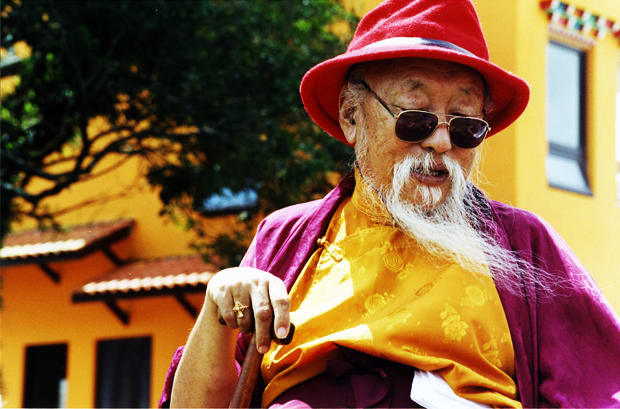
Chagdud Tulku Rinpoche was born in 1930 as Padma Gargyi Wangchuk in the Thromtar region of Kham in Eastern Tibet. His father was Sera Kharto Tulku, a lama of the Gelugpa School of Tibetan Buddhism. His mother was Delog Dawa Drolma, who was widely considered to be an emanation of Tara, and was from a Sakya family; she had a profound influence on her son’s spiritual life.
By the time he was three years old, Chagdud Tulku Rinpoche had been recognized as the incarnation of the previous Chagdud Tulku. Soon afterward he traveled to Temphel Gonpa, a monastery about two or three days by horseback from Thromtar. After a retreat, he received numerous teachings, empowerments and oral transmissions from a number of spiritual masters. One of them, Shechen Rabjam Rinpoche, told him that Tara meditation would become one of his major practices. Shortly after completing his first three-year retreat in 1945, he went to see Dzongsar Khyentse Chökyi Lodrö. Chagdud Tulku received the Rinchen Terzö empowerments from him, and also met Dilgo Khyentse at that time, who was also attending the empowerments. By 1946 Chagdud Tulku Rinpoche had entered his second three-year retreat, this time under the guidance of the Tromge Trungpa Rinpoche. Near the conclusion of this retreat, the death of Tromge Trungpa forced Chagdud Tulku to leave his retreat before its completion. He returned to Chagdud Gonpa in Nyarong, and after staying there for some time, he proceeded on a pilgrimage to Lhasa with an entourage of monks. This was followed by an extended retreat at Samye, the monastery built by Padmasambhava. Afterwards, he attended empowerments given by Dudjom Jigdral Yeshe Dorje, who would become a main teacher as well as a source of spiritual inspiration. Chagdud Tulku stayed in Lhasa during 1957, in the same house as Khenpo Dorje, whom he regarded as his root lama. Among his other teachers were Shechen Kongtrul, Tulku Arig and Dudjom Jigdral Yeshe Dorje.
Following the Chinese invasion of Tibet in 1959, Chagdud Tulku escaped along with Khenpo Dorje to India after enduring hunger and many dangers—it looked like they would be captured. His route took him through the Pemakö region of Tibet, and his group came out from there into the Indian state of Nagaland. Chagdud Tulku lived in a number of Tibetan refugee resettlement camps in India—Kalimpong, Odisha, Dalhousie, Bir, Himachal Pradesh, and Delhi. He practiced traditional Tibetan medicine, and was in great demand since his fellow refugees had trouble coping with the heat and the tropical diseases found in India. A year or two after his arrival in India, Rinpoche entered a retreat at Tso Pema, Padmasambhava’s sacred lake located near the city of Mandi, Himachal Pradesh. At Tso Pema he met Jangchub Dorje, a primary disciple of Apang Tertön and a lineage holder of this great terton’s Red Tara cycle. Jangchub Dorje gave him the empowerments for the Red Tara cycle, Chagdud Tulku re-entered retreat, and signs of accomplishment in the practices came very swiftly. Later, when he began teaching in the West, the Red Tara sadhana would become the meditation most extensively practiced by his Western students.
After giving a teaching in Kulu Manali, Himachal Pradesh, the 14th Dalai Lama extended an invitation for Rinpoche to go to the United States to teach, contingent upon his getting a visa. It was at this time that Chagdud Tulku moved to Delhi, where he lived in Majnu ka tilla, a Tibetan camp on the banks of the Yamuna River. The process of getting a visa went on for three years, and was ultimately unsuccessful. During this time period Rinpoche met his first Western students, but he also caught malaria and almost died. He was saved by an Indian doctor who finally made the correct diagnosis of what was ailing him.
In the fall of 1977, Dudjom Jigdral Yeshe Dorje gave empowerment cycles in Kathmandu, Nepal, in order to propagate the sacred lineages for a new generation. Chagdud Tulku decided to travel there in order to receive all the empowerments of the Dudjom treasures from Dudjom Rinpoche. Hundreds of tulkus, scholars, yogis and lay practitioners gathered at Dudjom Jigdral Dorje’s monastery, Orgyen Dho Ngag Choling at Tusal, Boudhanath, Kathmandu, Nepal for these empowerments. Rinpoche stayed in Nepal into 1978 in order to attend a new series of empowerments in the Chokling Tersar cycle given by Dilgo Khyentse. It was while attending one of these empowerments that a Western woman, Jane Dedman (later Chagdud Khadro) approached Chagdud Rinpoche with the offering of a white scarf and a jar of honey. He invited her to lunch afterwards, and shortly after this he gave her some teachings. A month or so later he accepted her offer to serve as his attendant in retreat after the empowerments. This retreat lasted for several months, after which Dudjom Jigdral Yeshe Dorje suggested among other things that Chagdud Rinpoche travel to America to teach. After many months of waiting, he was finally granted a visa and arrived in San Francisco on October 24, 1979.
In 1992 Chagdud Rinpoche received an invitation to teach in Brazil, where he would become a pioneer in spreading the Dharma in South America. He maintained an extensive teaching schedule throughout the 1990s, put some of his senior students into three-year retreats, and helped to establish many Chagdud Gonpa centers throughout the Western Hemisphere. These include more than thirty-eight Dharma centers under Chagdud Tulku’s supervision and inspiration in the USA, Brazil, Chile, Uruguay, Switzerland and Australia. The best known are Rigzin Ling in Junction City, California, and Khadro Ling, the seat of Chagdud Gonpa Brasil in Tres Coroas, Brazil. While Chagdud Rinpoche maintained a tremendous amount of Dharmic activity, in the last few years of his life he was slowed down somewhat by diabetes. In 1997 he was diagnosed with a serious heart condition. In the last year of his life, Rinpoche’s body began to hinder his outer activities. He tired more easily, and travel became difficult. He cancelled a trip to the United States in 2002, and instead entered into a strict retreat. In the last week of his life, he concluded his retreat on Tuesday, November 12th, 2002, worked with a student artist to complete a statue of Amitabha, talked with many of his students, and led a training in phowa (the transference of consciousness at the moment of death) for more than three hundred people. He continued teaching with great vigor until about 9:00 p.m. on Saturday, November 16. Then on Sunday morning the 17th at about 4:15 a.m. Brazilian daylight time, he suffered heart failure while sitting up in bed. He remained in a state of meditation, with no deterioration of his physical form, for over five days after his last breath. Then he was taken from Brazil to Nepal, where his cremation took place.